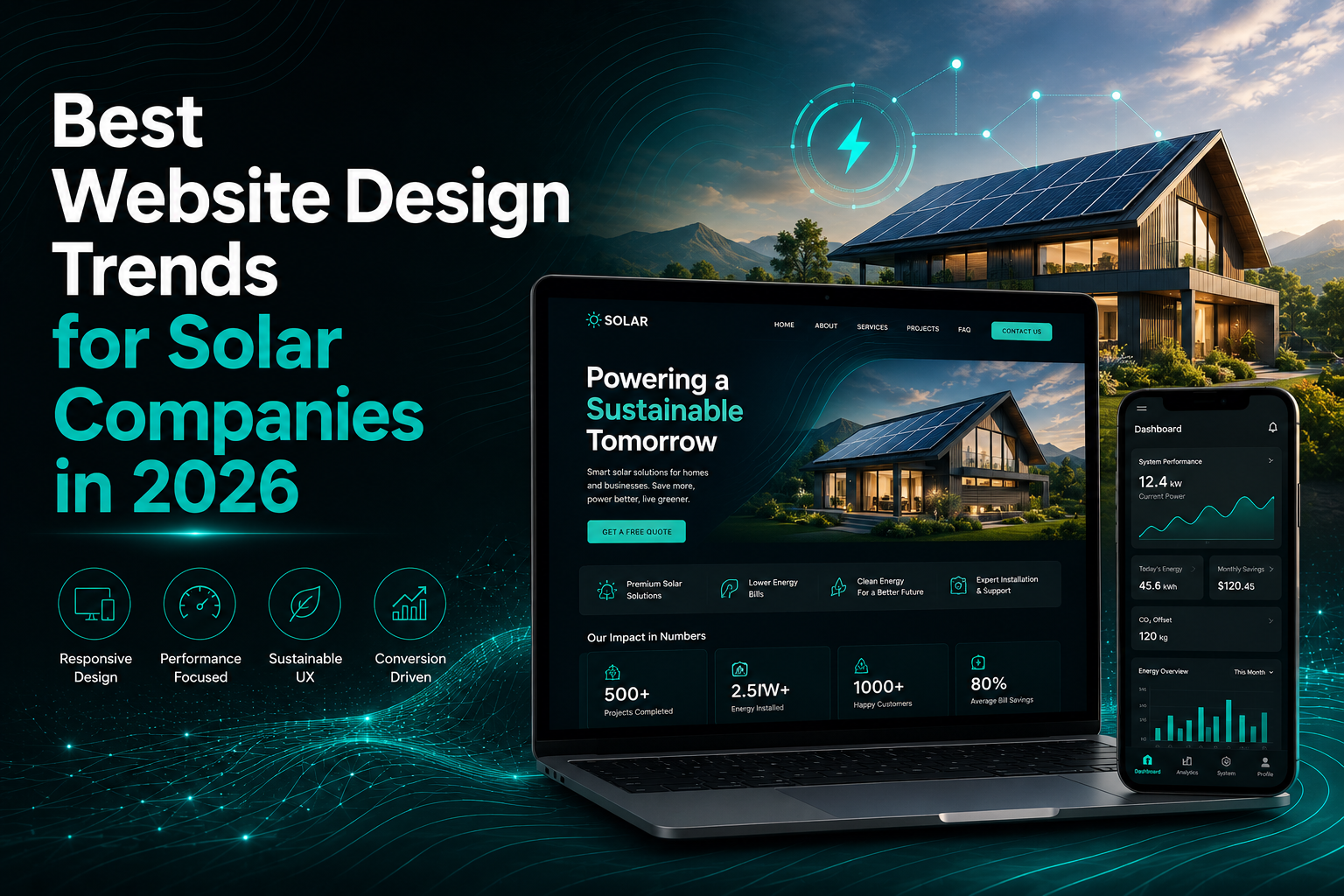
The solar industry is growing fast. More people are searching for solar solutions online every single day, and most of them are making decisions based on what they see on company websites before they ever speak to anyone.
Your website is either winning that moment or losing it. In 2026, website design trends are making a very clear difference between solar companies that generate steady leads and those that struggle to get noticed online.
Before someone calls you, they visit your website. They scroll for a few seconds, form an opinion, and decide whether you feel trustworthy. Solar company marketing today lives and dies on that first digital impression.
Every ad, every social post, every referral eventually sends someone to your website. If that experience feels outdated or confusing, you are quietly losing business every single day.Website Design Trends Actually Working for Solar in 2026
Generic stock photos no longer fool anyone. Solar companies using real installation photos, actual customer rooftops, and genuine project results are building far more credibility online. For solar digital marketing, authentic visuals do more heavy lifting than any written claim ever could.
Responsive web design in 2026 means designing for the phone before anything else. Most people researching solar are doing it from their smartphones. If your forms are long, your buttons are small, or your pages load slowly on mobile, you are losing visitors before they even read your offer.
Google Core Web Vitals measure your page loading speed, layout stability, and responsiveness. Google uses these scores in search rankings directly. For digital marketing for solar companies, a slow website is not just a user experience problem - it is a visibility problem that keeps potential customers from finding you in the first place.
AI website design are helping solar companies show more relevant content to different visitors. A homeowner and a commercial property manager have completely different needs. Smart websites recognize this and adjust the experience accordingly. AI chat tools are also handling early questions and qualifying leads around the clock, which strengthens overall solar lead generation without adding staff.
Sending paid traffic to your homepage is one of the most common mistakes in solar company marketing. A dedicated landing page design for each campaign removes distractions and focuses the visitor on one single action. This straightforward approach is the most reliable method of conversion rate optimization available and consistently produces more inquiries from the same budget.
Website user experience is about removing friction. Shorter forms, clearer navigation, and obvious call-to-action buttons make it easier for visitors to say yes. The solar websites performing best right now are not the most complicated ones. They are the cleanest and most straightforward ones.
Reviews, certifications, and real customer testimonials build the confidence a visitor needs before reaching out. But they only work if people see them. Placing these trust signals near the top of your key pages - not buried at the bottom - is one of the simplest improvements any solar company can make to their solar digital marketing right now.
Visitors do not wait. If your website takes more than three seconds to load, most people are already gone before your homepage even appears. In 2026, Google Core Web Vitals made page speed a direct ranking factor, meaning a slow website hurts you twice - once with visitors and once with search visibility.
Responsive web design ensures your pages load cleanly across every device without unnecessary
delays
Compressed images and lightweight code keep your website user experience smooth and frustration
free
Faster loading pages directly improve your conversion rate optimization by keeping visitors
engaged long enough to
take action
A lot of solar websites are written for algorithms. The pages are packed with keywords but say nothing that actually helps a real person make a decision. That approach stopped working a while ago.
In 2026, the solar companies getting real traction online are writing content that answers genuine questions - how much will this cost, how long does installation take, what happens on a cloudy day. That kind of honest and helpful content builds trust before a single conversation happens.
Clear and straightforward messaging supports stronger solar company marketing without feeling
pushy or robotic
Helpful content naturally improves solar lead generation by attracting visitors who are already
seriously
considering a purchase
Honest answers on your landing page design reduce hesitation and move people closer to reaching
out
The solar companies pulling ahead in 2026 are not always the biggest ones. They are the ones who treat their website seriously - keeping pages fast, making mobile experience smooth, using real photos, and building focused landing pages that guide visitors toward action.
Digital marketing for solar companies is more competitive than it has ever been. But the companies winning online are not always the ones spending the most - they are the ones who got the basics right first.
A well-built website brings in better leads, builds real trust, and makes every other marketing effort work harder. Fix the foundation, and the results will follow.